Oh, for Pete's sake! Just what I need - more proof of how hopelessly behind in my reading I am.
The 2010 National Book Award finalists have been announced, and I've only read one of the books in the Young People's Literature category (One Crazy Summer by Rita Williams-Garcia)and one from Fiction (So Much for That by Lionel Shriver).
Can we please add about 2 hours to each day, just for reading?
Thursday, October 14, 2010


Tuesday, October 12, 2010
A Chompo bar for my sister
 On a long run, I always carry a Clif bar in case of hunger pangs. As the bar becomes squeezed and misshapen in my sweaty grasp, I always think about Russell and Lillian Hoban's A Birthday for Frances.
 Frances, although conflicted about her little sister Gloria's upcoming birthday, uses her allowance to buy Gloria a Chompo bar and four bubblegum balls. All the way home from the store, Frances ponders the goodness of Chompo bars and the fact that Gloria is awfully young for that kind of candy, and meanwhile she pops the bubblegum balls in her mouth and squeezes the Chompo bar harder and harder. Gloria does eventually get that Chompo bar, despite more bouts of anguish on Frances' part, but only after even more Chompo-squishing in Frances' hot little paw.
I have a little sister of my own, and although I don't remember being jealous of her on her birthdays (perhaps knowing that mine would be coming only a month later), I was certainly aware of my duty as big sister to do what I could to tame a bit of that irrepressible, busting-out-all-over Little Sister personality. And my sister is a Leo, too! The danger to humanity was extreme. I'm convinced that my occasional necessary squelching of obnoxious little sister behavior helped make her the confident, well-adjusted, and decent person she is today.
It may be big sister Frances who is the exuberant main character in that wonderful picture book series, but often it's the little sisters who star. A book I pored over again and again as a child was Sarah's Room by Doris Orgel and illustrated by Maurice Sendak, in which little sister Jenny yearns to be allowed access to the glories of her big sister Sarah's room, with its pretty wallpaper, dollhouse and tiny treasures. I would never have scribbled on the wall as Jenny did, but on the other hand I was in awe and admiration at Sarah's tidiness - and so I identified, as readers were meant to, with young Jenny - who proves that she is capable of growth and change. Even big sisters can feel the frustration of being too young.
 In Beezus and Ramona, the main character is clearly big sister Beezus, whose frustrations with little sister Ramona the reader feels strongly, but as the series continues, the focus turns to Ramona's thoughts and feelings, turbulent as they are. I read and re-read these books with total absorption, despite the fact that Ramona was often as perplexing to me as she is to Beezus. On the other hand, Ramona is often mystified herself by her overwhelming emotions and urges. That Ramona wants to pull on a classmate's boing-boing curls, just to watch them sproing, I can imagine. To actually DO it - well, that's a little sister for you. But it's brave Ramona who, in desperation, throws her own shoe at a scary dog blocking her path on the way to school, and then has to spend a day at school with only one shoe. That's little sister pluck. I was and am Beezus, but that Ramona, mysterious and volatile, has my heart.
Big sisters may do a bit of little sister squelching, for the good of humanity, but they are often fiercely protective as well. I just finished The Replacement by Brenna Yovanoff (review coming soon), in which a big sister's love and protection of her strange and unnatural little brother ensures his survival in a hostile world. And in Sisters Red by Jackson Pierce (the book I'm reading now), Scarlett saved her little sister Rosie from a brutal werewolf attack as a young child, and can't stop protecting her even now.
During a family trip to the Grand Canyon many years ago, my older daughter was terrified whenever her little sister got within 10 feet of the edge, convinced that in typical little sister exuberance, she'd somehow manage to topple into the Canyon. She worries about her even now. "She reads too much fantasy. If she read more realistic books, she'd know what happens when you do dumb stuff," my older daughter said to me earnestly, pointing out that in YA books, risky behavior is often followed by unwanted consequences. "She doesn't even realize all the bad stuff that can happen."
Or, being a little sister, she is simply less risk-averse. Or perhaps I should say that little siblings in general are more prone to behavior that others might find odd. After all, it was not sensible big brother Peter but rather his little brother Fudge who ate Dribble the turtle in Judy Blume's Tales of a Fourth Grade Nothing.
My sister never ate a turtle. But even if she did, I'd still give her a Chompo bar for her birthday or any time, with only a bit of squishing for extra luck and love.
Friday, October 8, 2010
Review of Turtle in Paradise by Jennifer L. Holm

When her mom gets a job as a live-in housekeeper with a lady who doesn't like kids, Turtle has to spend the summer with her aunt and cousins down in Key West, Florida. She hangs out with a bunch of boys who are members of the Diaper Gang (they watch babies in exchange for candy), meets a couple of relatives she never knew she had, searches for pirate treasure, and hopes that someday her dreams of living in a cute little house with her mom will come true.
It's 1935, and from the first page the reader is plunged into a world of Necco wafers, Ford Model As, and dusty travelers. But it isn't just a bunch of Depression-era term-dropping that brings the era alive, but rather the way that Holm uses Turtle's spunky narrative voice, the wise-cracking dialogue of the Diaper Gang, and all kinds of details large and small to great effect. In our over-protective world, it's down-right exotic to hear how these young and dirty boys haul babies around with casual and careless abandon, while the babies' moms are just happy to have some peace and quiet, and would never dream of being worried. And the snappy comebacks of the kids, especially Turtle and her cousin Beans, are reminiscent of some of the edgier Our Town episodes.
It's not that this is fiction of a hugely realistic sort. The tone is a bit too off-hand, there are a bit too many funny bits and pieces, and of course there's the matter of that pirate's treasure, not to mention a certain very famous writer. In fact, this is very much like a 1930s movie (maybe a Shirley Temple movie but without the sickly sweetness or Shirley Temple). And I mean that in a good way. For instance, there's a fabulous fairy-tale ending - but then disaster strikes. But then it all works out anyway, and much more satisfactorily! One can only sigh contentedly, as after a funny but touching movie.
I do believe that kids will find this blend of adventure and light slice-of-life quite entertaining, and the back matter, with true stories and photos about Key West and Holm's ancestors, adds even more value.
Highly recommended for ages 9 - 11.
Thursday, October 7, 2010
SoCal YA authors for Teen Read Week
An intriguing and eclectic group of YA (and some middle-grade) authors will be making appearances at 14 branches of the Los Angeles Public Library in just over a week!
Teen Read Week is fast approaching, so study this list to find out where to find Cecil Castelucci, Mark London Williams, Heather Tomlinson, Michael Reisman and 16 other talented authors during the week of Oct 18 - 23.
Teen Read Week is fast approaching, so study this list to find out where to find Cecil Castelucci, Mark London Williams, Heather Tomlinson, Michael Reisman and 16 other talented authors during the week of Oct 18 - 23.
Tuesday, October 5, 2010
Review of The Grimm Legacy by Polly Shulman

Shulman, Polly. The Grimm Legacy. Putnam, 2010.
Elizabeth's mother read Grimm fairy tales to her when she was a young child, and Elizabeth's life has become something of a Grimmsian tale itself, what with her mother dying, her father remarrying, a new task-master stepmother, and two selfish older stepsisters. She is ripe, therefore, for the wonders of The New-York Circulating Material Repository, where she is hired as a page, and in particular its magical Grimm Collection.
The concept of a library that lends out objects - historical, rare, valuable, or simply interesting - is exotic enough, but to lend out magical objects seems to beg a whole host of problems. Sure enough, Elizabeth and her teen-aged fellow pages are soon embroiled in a dangerous search for the entities who are stealing powerful magical objects from the Grimm Collection.
Being an ordinary Muggle-type schmo with no magical ability whatsoever, I find fantasies about magic that can be worked by anyone, regardless of innate magical talent, to be rather alluring. While a wand from Ollivander's would open no doors for me, no matter how many times I shouted "Alohomora," the stick from the Grimm tale "The Raven" would open any door I (or anyone else) hit with it, no questions asked.
Which raises plenty of questions about how easy it would be for this kind of magic to become common-place. Knowledge has a way of spreading, so if a piece of yarn, knotted and muttered over in a certain way, protected someone from magical harm, wouldn't every teen suddenly know how to do this, the way they all seem to know how to make a friendship bracelet? And if there really were magical objects that could be used by anyone, they'd all be in the hands of rich and powerful folks. Which is of course the point of the Repository - to protect these objects while still allowing their use - but I can't help but think that this protection is mighty slim, particularly taking into account the folks who know about the Grimm Collection and all the other mind-boggling special collections at the Repository.
That is all rather beside the point, however. This tale is a imminently readable blend of a contemporary urban fantasy (and with no faeries, vampires, or werewolves!) and a timeless Austen-esque romance in which the girl won't admit to herself that the guy who has been irritating the heck out of her is really the man of her dreams - or at least fine boyfriend material. There is danger and intrigue, and if Elizabeth's family members remain absolutely one-dimensional and stereotypical, that just proves how really fairy tale-like they are. This is a charming fantasy - AND it has librarians and pneumatic tubes, making it awesome indeed.
Recommended for ages 13 and up.
Monday, October 4, 2010
Ho ho ho
How did you spend your summer vacation? A small and dedicated group of Los Angeles Public Library (and ex-LAPL) folks spent June, July, and August reading and reviewing December holiday books for School Library Journal, in the hope that our reviews will help you spend those meager book budgets wisely and well. And hurray, there are some fine books to choose from this holiday season.
Merry Christmas to all, and to all a good pphhhbbbttt.... (which is how we all felt, dozens of holiday books later...).
Merry Christmas to all, and to all a good pphhhbbbttt.... (which is how we all felt, dozens of holiday books later...).
Saturday, October 2, 2010
Review of The Strange Case of Origami Yoda by Tom Angleberger
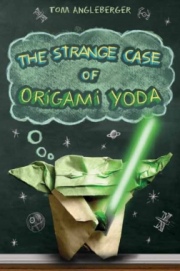
Angleberger, Tom. The Strange Case of Origami Yoda. Amulet Books, 2010.
The problem with a lot of really funny books is that they don't portray a version of life that is particularly realistic. Sure, they might be hilarious - but it's not as if one reads them thinking "oh man, that is just SO true" or "wow, did this author actually get inside my brain?"
How fabulous, then, to read a book that is not only extremely funny but is actually strangely close to matching my memories of junior high school, which was populated by more intensely strange and nerdy children than you would believe. In 1978, it was a brand new magnet school called the Center for Enriched Studies (now quite renowned and difficult to get into), and somehow it attracted ueber-dorky kids of all ethnicities (or rather, it attracted their parents). We didn't have our own campus, and therefore we spent the first three years on three different campuses (the first year, our classes were held on the grounds of the gorgeous Wilshire Boulevard Temple). We had no gym, no lockers, no cafeteria - but the classes were challenging and the teachers were first-rate. It was a nerd breeding ground.
What does this have to do with Origami Yoda? Everything! I knew kids just like Tommy, Harvey, Kellen, and especially Dwight. And you know, they were FUNNY. Yes, they goofed around and acted like fools - but they also did Yoda imitations, Monty Python imitations, were always ready with wisecracks and one-liners, and could be really hilarious. That's what this book reminded me of - hanging out and kidding around with the dorky guys at school (because the cool, good-looking guys were way out of my league, and anyway they didn't seem very nice OR funny).
Plot in a nutshell: Dwight, Inexplicably Weird Boy Extraordinaire, makes an origami Yoda, puts it on his finger, and gives advice and/or predicts the future. Strangely, the advice is often wise and has good results, leading Tommy and many other 6th-graders to wonder if the origami Yoda could be really channeling Yoda or another wise spirit. After all, Dwight is just too weird to come up with that stuff. Tommy and other kids take turns telling Yoda anecdotes, while sceptical Harvey weighs in with dissenting opinions.
These kids talk, bicker, and obsess just like those Center for Enriched Studies dorks of yore. All dialogue is startlingly authentic, as is the humor. Does the fact that I still find Yoda imitations funny mean that my sense of humor has never progressed beyond middle school? (I have driven my children crazy with this Yoda admonition - "No. Try not. Do... or do not. There is no try.") The illustrations are likewise very middle school-esque.
Best of all, there are some lessons learned, both of the small and inconsequential variety and the poignant sort. Dwight, of course, is the true hero of this tale. He remains an enigma, but as kids learn to look beyond the Yoda on his finger and really see him, they begin to understand what a complex and fascinating (if utterly unpredictible and still bizarre) person he is.
Highly recommended for everyone ages 9 and up. Read this you must.
The problem with a lot of really funny books is that they don't portray a version of life that is particularly realistic. Sure, they might be hilarious - but it's not as if one reads them thinking "oh man, that is just SO true" or "wow, did this author actually get inside my brain?"
How fabulous, then, to read a book that is not only extremely funny but is actually strangely close to matching my memories of junior high school, which was populated by more intensely strange and nerdy children than you would believe. In 1978, it was a brand new magnet school called the Center for Enriched Studies (now quite renowned and difficult to get into), and somehow it attracted ueber-dorky kids of all ethnicities (or rather, it attracted their parents). We didn't have our own campus, and therefore we spent the first three years on three different campuses (the first year, our classes were held on the grounds of the gorgeous Wilshire Boulevard Temple). We had no gym, no lockers, no cafeteria - but the classes were challenging and the teachers were first-rate. It was a nerd breeding ground.
What does this have to do with Origami Yoda? Everything! I knew kids just like Tommy, Harvey, Kellen, and especially Dwight. And you know, they were FUNNY. Yes, they goofed around and acted like fools - but they also did Yoda imitations, Monty Python imitations, were always ready with wisecracks and one-liners, and could be really hilarious. That's what this book reminded me of - hanging out and kidding around with the dorky guys at school (because the cool, good-looking guys were way out of my league, and anyway they didn't seem very nice OR funny).
Plot in a nutshell: Dwight, Inexplicably Weird Boy Extraordinaire, makes an origami Yoda, puts it on his finger, and gives advice and/or predicts the future. Strangely, the advice is often wise and has good results, leading Tommy and many other 6th-graders to wonder if the origami Yoda could be really channeling Yoda or another wise spirit. After all, Dwight is just too weird to come up with that stuff. Tommy and other kids take turns telling Yoda anecdotes, while sceptical Harvey weighs in with dissenting opinions.
These kids talk, bicker, and obsess just like those Center for Enriched Studies dorks of yore. All dialogue is startlingly authentic, as is the humor. Does the fact that I still find Yoda imitations funny mean that my sense of humor has never progressed beyond middle school? (I have driven my children crazy with this Yoda admonition - "No. Try not. Do... or do not. There is no try.") The illustrations are likewise very middle school-esque.
Best of all, there are some lessons learned, both of the small and inconsequential variety and the poignant sort. Dwight, of course, is the true hero of this tale. He remains an enigma, but as kids learn to look beyond the Yoda on his finger and really see him, they begin to understand what a complex and fascinating (if utterly unpredictible and still bizarre) person he is.
Highly recommended for everyone ages 9 and up. Read this you must.
Subscribe to:
Posts (Atom)