Monday, October 25, 2010

Breakfast with Jacqueline


There's no better way to start the day than by breakfasting at the Skirball Center with dozens of writers, librarians, teachers, and fans of literature for young people, and that's what I plan to do on Saturday, November 6th. After breakfast, Jacqueline Woodson (Jacqueline Woodson!!!) will give a talk, and if that's not enough excitement, Marla Frazee, Kathleen Krull, Mary E. Pearson, Hope Anita Smith, and Andrew Smith will be receiving awards.

AND Maureen Wade, Librarian Extraordinaire, will be honored with the Dorothy McKenzie Award for Distinguished Service to the Field of Children's Literature.

AND there will be oodles of books to buy and get signed ('cause the holidays are right around the corner).

AND then attendees get to visit the Skirball Cultural Center exhibits for free (check out the Maira Kalman exhibit, among other nifty things).

If you're in Southern California, this is an event not to be missed. So get yourself over to the Children's Literature Council website and Sign up today!

Review of Out of My Mind by Sharon Draper


Draper, Sharon. Out of My Mind. Simon & Schuster, 2010.

In 5th grade, things finally begin to change for Melody. Unable to walk, talk, eat without assistance, or control most of her movements thanks to cerebral palsy, she has been relegated to Special Ed classes for years. However, when she gets to go to music class and begins to meet some other 5th graders, her world begins to open up.

Although no one seems to be able to tell, Melody is really smart. Blessed with an amazing memory and an urge to suck in everything she sees, hears, and reads, all her knowledge and thoughts are just simmering inside of her, yearning to burst out. A special computer that enables Melody to communicate allows her to let her mind off its leash and experience a full gamut of 5th grade experience, including a Whiz Kids competition.

This book is all about the pleasure of listening to Melody's feisty, dry voice as she narrates her tale. The idea of being imprisoned in one's own uncontrollable body, unable to communicate even the simplest ideas, is a horrifying one, and yet Melody manages to portray her life in a matter-of-fact and even humorous manner. Her situation sucks hugely, as she will be the first to admit, but it's what she's always known. And she has what have to be the most awesomely patient and fabulous parents in existence.

Harder to take are the reactions of her classmates to Melody. Even the nice ones would rather not deal with her most of the time, and Melody knows that her occasional involuntary drooling, shrieking, and kicking are all pretty off-putting, not to mention that she can't speak. And yet the person inside is a composed, funny, warm, smart girl. The contrast is so great that even after she can use her computer to compose witty responses, her classmates can't quite believe that Melody isn't stupid. It's horribly frustrating and painful.

Some circumstances seemed a bit contrived - for instance, a dramatic and scary scene involving Melody's sister feels unnecessary, and the obligatory mean girls never rise above stereotypes - but mostly the scenes and characters feel warm and real. Melody may often seem wise beyond her years, but hey, she's had a lot of time to think and observe. And that sassy, eye-rolling humor and her penchant for slang land her back squarely and appropriately in tween territory. Is Melody black? I don't remember if it's ever explicitly stated. Sharon Draper is black, and Melody describes herself and having short, dark, curly hair - but no one's race is mentioned, that I can recall.

The jacket art is crisp and appealing (it reminds me of Cynthia Lord's Rules - must be the fish), the title, with its double meaning, is clever, and the story will grab most 5th graders. Highly recommended for ages 9 to 12.

Friday, October 22, 2010

Opera Dogs and more


If you're in the Los Angeles and want a great reason to visit Central Library, drop on by tomorrow afternoon.

We've got two Performing Books shows happening at 2 and 3 pm, and the featured book is The Dog Who Sang at the Opera by Jim West and Marshall Izen. A storyteller (Peter Kors), an opera singer (Heather Calvete) and a pianist (Linda Zoolalian) bring the story to life, accompanied by slides of illustrations from the book.

It's free! Bring along a kid and prepare to have a musical afternoon. And don't forget, parking is only $1 under the library with validation!


Thursday, October 21, 2010

Eva Ibbotson


I just found out that Eva Ibbotson passed away yesterday at the age of 85.

She is one of those authors whom you feel you get to know well, just by reading her books. Her books, from the light yet satisfying fantasies like Which Witch and The Secret of Platform 13 to her historical novels such as The Star of Kazan and The Dragonfly Pool, are funny, wise, magical, and wonderful - and I'm sure that Ms. Ibbotson was exactly the same. I was lucky enough to be assigned several of her novels to review for School Library Journal over the years, and it was always a joy.

If you want a treat, go to the library or bookstore, choose any Ibbotson novel, and read it tonight - and then recommend it to a friend. That would be the perfect tribute to this fine writer.

Wednesday, October 20, 2010

Review of Ship Breaker by Paolo Bacigalupi


Bacigalupi, Paolo. Ship Breaker. Little, Brown and Company, 2010.
Nailer (who might be 14, might be 15 - he isn't sure) scrapes out a living by crawling through the ducts of old, long-wrecked oil tankers, pulling out copper wire and anything else valuable he can find for his crew. He and the rest of the ship breakers live day to day in temporary shacks made of found junk, hoping to survive to adulthood and beyond.

After a huge storm (a "city killer"), Nailer and his friend Pima find a wrecked clipper ship, which is the term for the light and incredibly fast ships that use sophisticated materials and technology to skim along the ocean's surface on hydrofoils. In the wreck is a girl named Nita, a "swank," who has lived a life Nailer can't even imagine. Against his better judgment, he helps her to escape both the people who have been chasing her and also his own dad, whose villainy knows no bounds - and this decision changes his life.

This is dystopian science fiction but it could just as easily, with some tweaks, take place today. Nailer lives in a Gulf Coast hit by city-killing hurricanes and flooded by rising ocean levels. Oil is a fuel of the past, hence the crippled, obsolete oil tankers, and in fact the earth has been stripped clean of much of its resources. However, the bare and harsh existence Nailer has lived since he was born looks a lot like that of a slum child in India or Brazil or many other third-world countries. Nita, the rich girl, would never call her world a "dystopia" - for her, it's a paradise until it turns upside down.

Nailer isn't always likable. Although he's obviously a good person, his brutal life has made him tough and pragmatic, and he doesn't always waste time being nice. And yet he's clearly so decent and even fragile (being young and not a psychopath) compared to those around him. Except for Nailer, we don't get much of an understanding of the characters, but most of them are fairly interesting and one in particular is fascinating - that of the intriguing dog-man Tool (yes, he's genetically altered), bred to be a loyal fighter bound to a patron but somehow fiercely independent.

This is gritty and violent SF, with little glamor or even advanced technology (except for those clipper ships and a fancy train). It feels much more realistic and likely than another drowned-Earth book, Raiders' Ransom by Emily Diamand (my review), in which the surviving citizens of England have formed clans that resemble something out of the Dark Ages. It's hard to read about the almost insurmountable rift between the millions of teeming masses barely able to survive and the few rich elite - especially since that situation does exist in our world today.

A bit of swash-buckling adventure on the high seas adds a final exciting element to this tale (not to mention giving characters and readers some welcome relief from the muddy, oily coastal setting we are mired in for most of the story), making this all the more recommended for ages 12 and up.

Note: This title is a finalist for the 2010 National Book Award in the category Young People's Literature

Tuesday, October 19, 2010

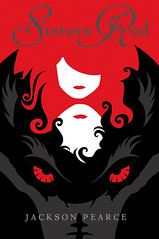
Review of Sisters Red by Jackson Pearce


Pearce, Jackson. Sisters Red. Little, Brown and Company, 2010.

Big sister Scarlett saved her little sister Rosie from a Fenris, or werewolf, when she was only 11 years old, but she lost an eye and gained many ugly scars in the attack. Seven years later, the sisters live to hunt Fenris, luring them with their lurid red capes and long hair to secluded areas, then fighting them to the death with well-honed knives and skill. Fenris, always men, prefer to devour young girls and women, the fluffier and more helpless the better, and the sisters want to save as many girls as they can from that fate.

Except Rosie is not quite as dedicated to the hunt as is Scarlett, especially when their good-looking neighbor and fellow Fenris-hunter Silas comes back from a long trip to California. Silas and Rosie begin to see each other as more than old friends, just when a huge influx of Fenris to their part of Georgia signals that the werewolf packs are looking for a Potential in the area - a boy or man who is ripe to be "turned." The three Fenris-hunters don't know who this person is or what makes a man a Potential - but Scarlett is determined to prevent this Turning from happening, and of course to kill as many Fenris as possible in the process. A move to Atlanta puts them right into the thick of things, and Scarlett goes into a frenzy of hunting while Rosie wonders if there could possibly be more to life than killing Fenris - like maybe falling in love.

Told from both sisters' points of view in alternating paragraphs, this is an intense, violent, and often gruesome story. The obvious parallels to the traditional Little Red Riding Hood tale add a bit of poignancy to the tale but also result in a too-literal re-interpretation of certain elements of the story that sometimes raises questions when the reader should be fully immersed in the unfolding events.

The red capes are excellent, and I'll buy the red names of the sisters, the fact that they lived with their Grandma, and the fact that Silas comes from a family of woodsmen. The all-male Fenris and their single-minded desire for succulent young girls and women strikes me as an oversimplified interpretation of the meaning of the wolf in the traditional tale, but I'll roll with it, especially since it's so supremely satisfying (if utterly unbelievable) to watch Scarlett and Rosie kicking major werewolf butt over and over.

I did wonder, however, why there are so many Fenris swarming all over Georgia. Surely, with all those attacks on young women that leave them pretty much just shreds of left-over flesh, someone would notice. And why are the Fenris so uniformly gorgeous in their human form? I won't reveal what makes a Potential, but it's rare enough that the Fenris can't be choosy about the looks of the guys who join their ranks. And why does Scarlett assume that there are only three Fenris hunters in the whole world? You'd think she'd go on the Internet and see if they could recruit more.

Okay, I get that it's a parable of sorts, but the thing is, the setting and characters are modern and realistic enough that these pesky questions do arise, and for me at least, they intrude into the tension of the story. But still, the tension does stay pretty high, the writing is smooth, and the emotional interplay between Rosie, Scarlett, and Silas is intriguing without detracting from the action. This tale is a must for fans of urban fantasy of the gritty, decidedly non-Faerie variety. And the jacket art is fabulous.

Recommended for ages 14 and up.

Monday, October 18, 2010

Review of The Replacement by Brenna Yovanoff


Yovanoff, Brenna. The Replacement. Razorbill, 2010.

My 16-year-old daughter is frankly incredulous that a fabulous fey creature like herself could have come from such conventional, plodding stock as her father and me. Although she hasn't actually claimed to be a changeling, I think that, deep down, she believes it.

I, on the other hand, was a clumsy and awkward teenager whose wish at all times was simply to be invisible (or to be outrageously beautiful and self-confident, natch, but that wasn't happening). Too tall, too skinny, too hairy, too blotchy - elbows too pointy, knees too knobbly, nose too pointy, chin too small, veins too visible - my god, I was a MONSTER!! Or so I was convinced.

16-year-old Mackie is also convinced of his essential wrongness. "I feel weird and freakish and pointless..." he says, and in fact he has good reason - other than being a teenager - to feel that way, being the real, honest-to-goodness changeling that he is. As a baby, he was placed in Malcolm Doyle's crib, the real Malcolm having been stolen by... those others. And so Mackie grows up like a cuckoo in the place of the human Malcolm, pale and black-eyed, unable to stand the sight or smell of blood, actively allergic to iron, and unable to enter consecrated places.

What makes this such an unusual and intriguing story is the fact that the Doyle family is not only fully aware of what Mackie is, but is determined to protect him and keep him safe. His minister father, his mother (with a strange past of her own), and most of all his sister love him despite the fact that he is not human and has replaced their own flesh-and-blood.

The whole town of Gentry knows what Mackie must be, but there is some pretty serious denial going on, particularly when you consider that there have been plenty of children going missing or dying over the years. Everyone knows what that they are living a creepy, unmentionable contract - in return for some of their children going missing (to be replaced by creepy creatures that usually die quite soon in this hostile iron-rich, human environment), their town will thrive - or at least, it won't die as so many neighboring towns have.

The story starts strong and just gets more intense, as Mackie meets his people for the first time and begins to get to know life under the mound. Although he is intrigued, he is appalled by the blood sacrifice demanded by one powerful ruler and by the acceptance of this by all the other creepy but non-bloodthirsty denizens of this underground realm. For the first time in his life, Mackie feels compelled to take a stand - and it's one that forces him to redefine "monstrous."

This is an eerie, deliciously shudder-inducing tale, filled with complexities and nuances that will keep readers pondering life in Gentry long after they finish the book. As fascinating as Gentry's hidden Folk are, what is most compelling is the strange way the humans of Gentry incorporate this knowledge of the Unnatural into their normal, everyday existence - going shopping, playing football, hanging out the laundry, but hanging iron horseshoes over their doors and scissors over cribs as well. And never, ever talking about it.

That Mackie is actually a very lucky Monster will be obvious to most readers early on, but doesn't occur to Mackie himself until later; he is blessed with a truly amazing family and some intensely loyal friends. They stick by him even when he feels most alienated, and they help him to understand what being a person (even if not a human) really means.

Perhaps one day soon my own little changeling will see the value of her own lumpen but loving family!

Highly recommended for ages 13 and up.